Agitated Individual in the Sanctuary
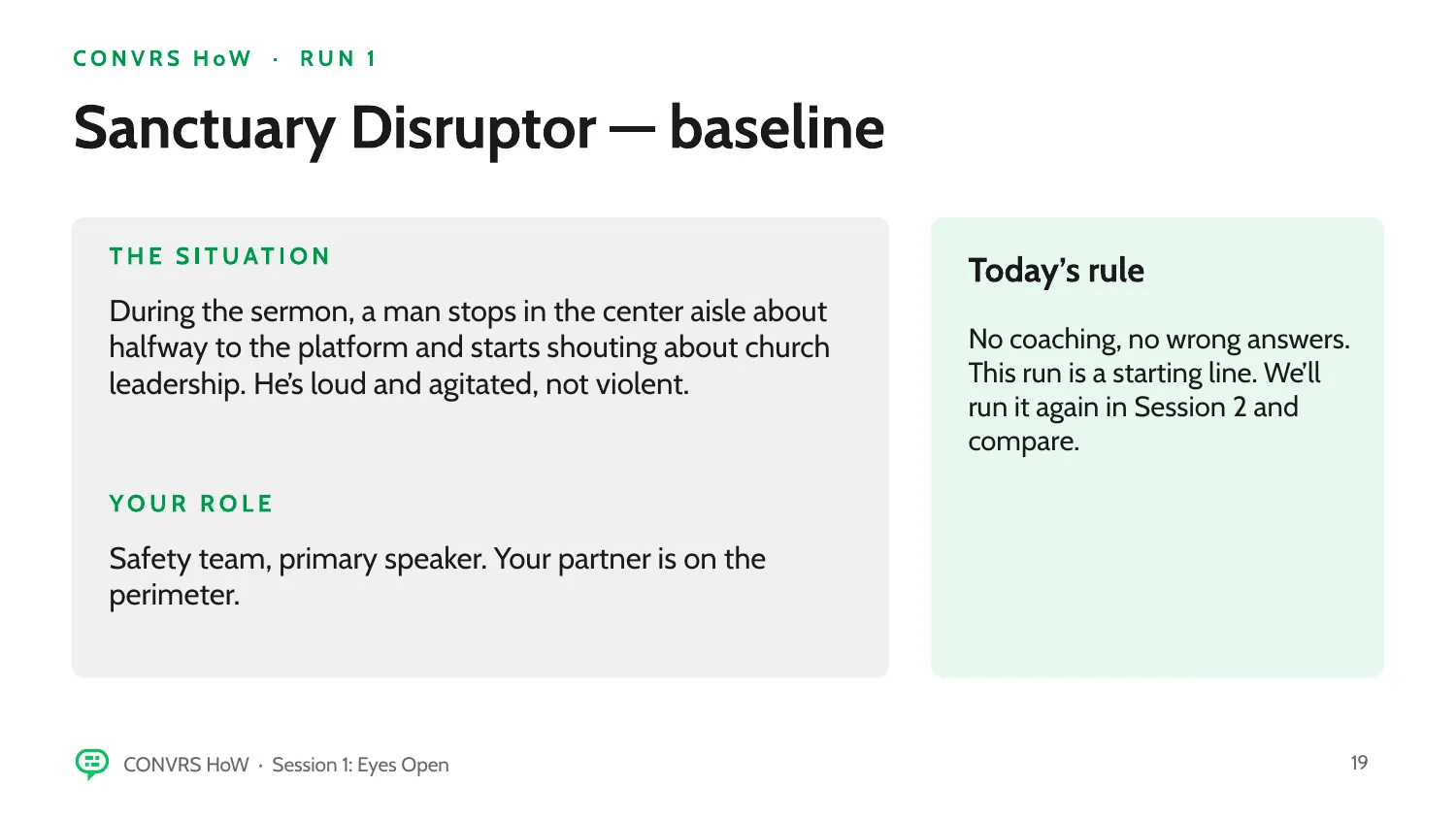
A man stops halfway up the center aisle and starts shouting about church leadership. Loud, not violent.
Success: a lower voice and an agreement to talk with a pastor after service, not an escort.
Greeters, ushers, and check-in volunteers practice hard conversations in a realistic and responsive simulation of real interactions. It all starts with a free five-session curriculum.
Create a free account to download.
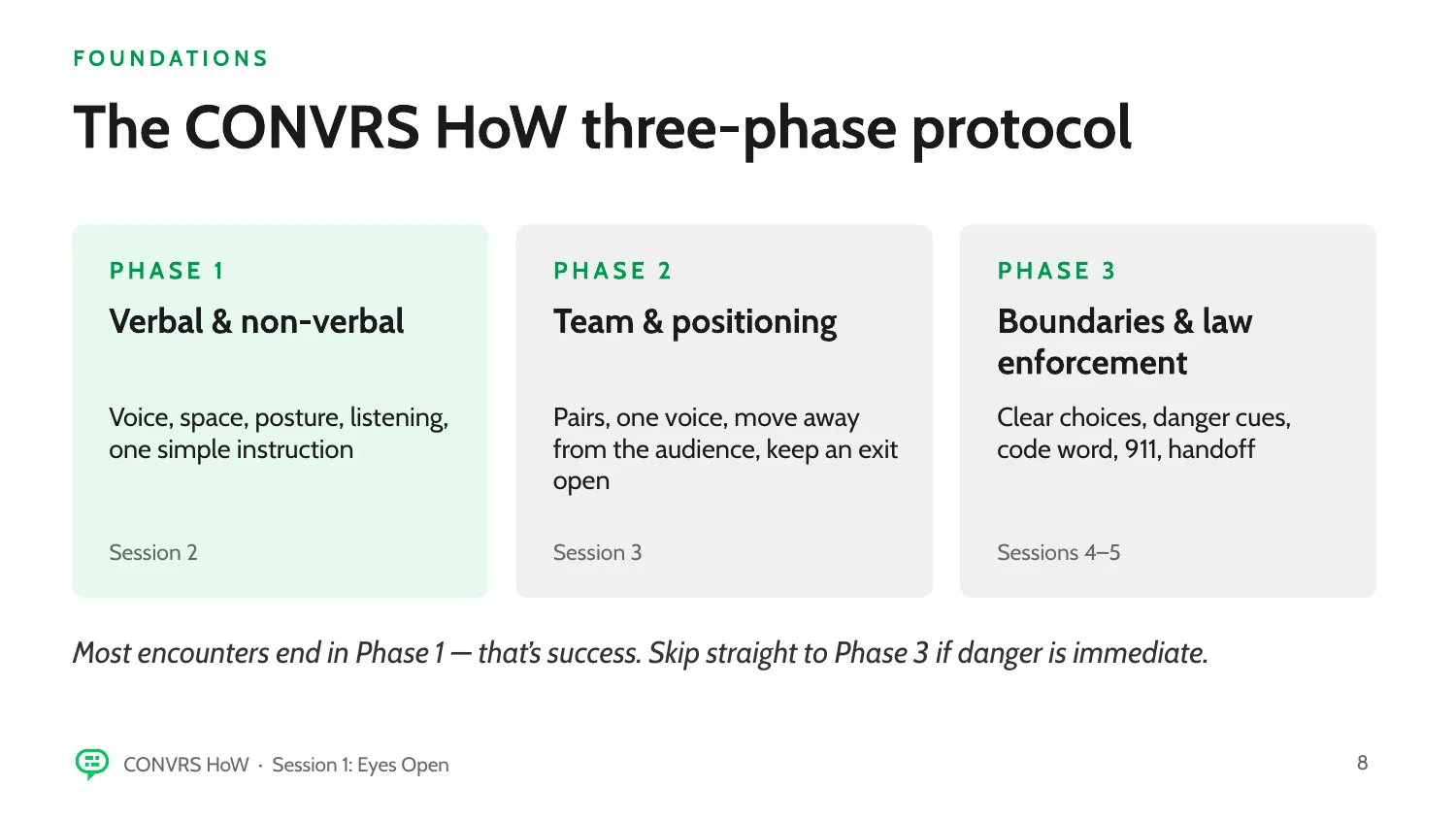
In a house of worship, communication breakdowns — not a lack of locks or cameras — are what turn a hard moment into a scene in the sanctuary, a child released to the wrong adult, or a person in crisis treated as a threat.
Safety time goes to locks, cameras, and active-threat briefings. Greeters get a name tag and a hope.
Lectures don't hold up under stress. Volunteer role-play is awkward, inconsistent, and usually avoided.
Volunteers change every season. A once-a-year training day resets every time someone new joins.
Built for Greeters & ushers · Children's ministry · Safety teams · Pastors & staff
Each scenario is a one-on-one conversation with an AI character who responds to what your volunteer says and how they say it. Patent-pending human capture plus generative AI: not a chatbot.
The volunteer learns the setting (sanctuary, foyer, check-in), their role, and what "good" looks like.
A one-on-one conversation with an AI character with realistic body language and expressions.
No script. Words, tone, and choices shape how the conversation unfolds.
See the choices you made and the ones you didn't, with a facilitator or on your own. Then run it again.
A safety lead or pastor runs the session. Volunteers take turns in the browser while the group watches on a shared screen. No tech skills needed.
A volunteer trains alone in the browser, and choice review does the coaching.
Either way, every volunteer is backed by a team: each session ends with "Know Your Campus" questions for the safety lead or pastor.
Five launch scenarios, one for each session of the curriculum. Every run can turn out differently.
A man stops halfway up the center aisle and starts shouting about church leadership. Loud, not violent.
Success: a lower voice and an agreement to talk with a pastor after service, not an escort.
Carol is frightened and overwhelmed, and thinks she's about to be thrown out. A crisis, not a threat.
Success: a quiet room, her sister called, and she doesn't drive home.
A well-liked member demands his daughter. The roster shows a court-ordered restriction.
Success: the door stays closed, without debating the order.
A visitor livestreams in the lobby, asks for names, and wants a look at the children's wing.
Success: a closed children's wing and a recording with nothing to post.
A non-member accuses his wife of infidelity with a church official. Empathy alone won't calm him.
Success: the code word used early, a held distance, and a calm wait for officers.
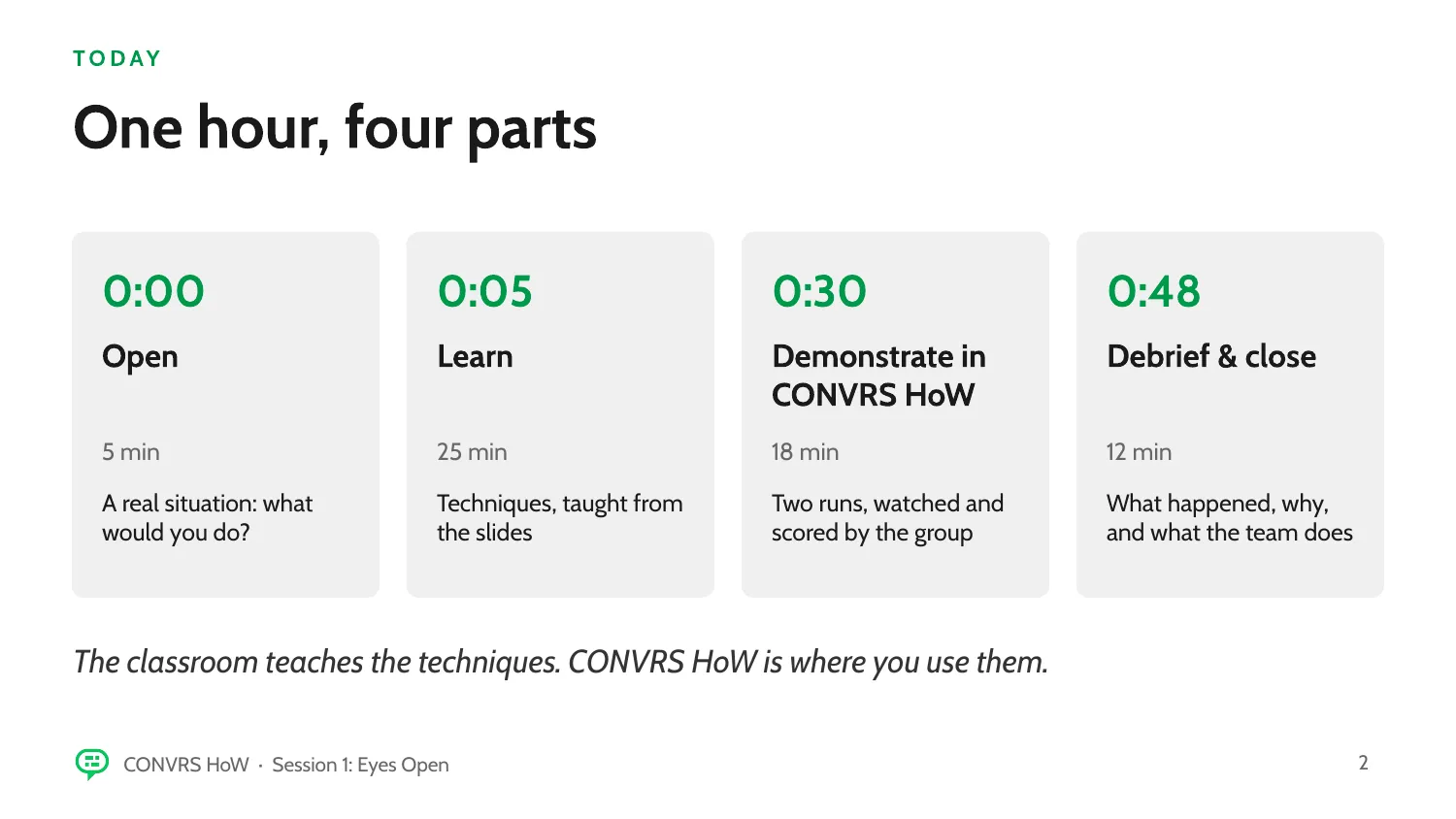
The sessions teach the techniques; CONVRS is where volunteers use them. About 60 minutes per session with a group, or 45 on your own.
After Session 5, each participant takes a Final Practice Run and receives a Certificate of Completion. No volunteer is ever expected to physically intervene against an armed or violent person.
Yes, every session's materials are free. They teach every technique on their own, but they're built to be used with CONVRS, because practice is where the skill sticks.
No. The course covers recognition, conversation, and calling for help. No volunteer is ever expected to physically intervene against an armed or violent person.
About 60 minutes per session with a group, led by a safety lead, pastor, staff member, or experienced volunteer (no technical skills needed), or about 45 minutes on your own. Practice reps take around 10 minutes, and one run per person each quarter keeps skills fresh.
No. It complements your safety plan, your relationship with local law enforcement, and hands-on courses such as Stop the Bleed. It trains the conversation that comes first.
No. Examples are drawn from church life, and the techniques apply to synagogues, mosques, and other houses of worship.
Some security grant programs allow training costs; confirm what is allowable with your state's administering agency before you apply. Congregations can keep a record of sessions and practice runs completed for trustees, insurers, and grant reports. Individual volunteers are not ranked or graded.
Book a demo and we'll walk through pricing and setup for your campus.
Book a demo and try the check-in desk scenario yourself.
Create a free account to download.
This curriculum is provided for educational purposes and is not legal advice.